
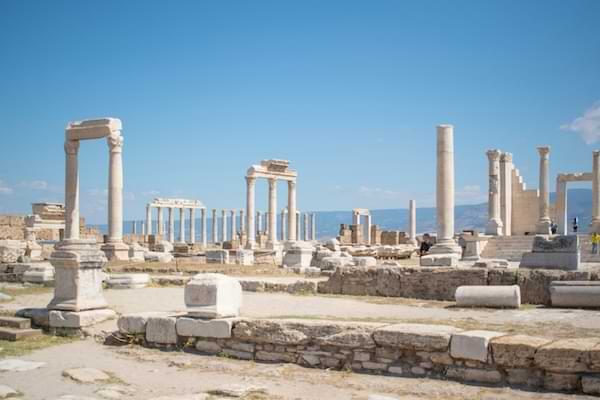
The seven churches – Laodicea
|
Getting your Trinity Audio player ready...
|
The seventh and final church Jesus addresses in the Revelation is the church in Laodicea. Laodicea was located near Colossae and Hierapolis in the fertile Lycus valley. A major Roman road ran from Ephesus straight through Laodicea, making it an important center for trade, commerce, and banking. The city was known for its much sought-after black wool and eye ointment for healing. It was also known for its great wealth, its large market, a medical school, and, additionally, for its inferior water supply.
Despite its abundant wealth and possessions, Laodicea had terrible water. The city received its water from an aqueduct about six miles long. The water came from a hot spring in the south or a natural spring of cool water. Regardless of the source, once the water traveled six miles, it arrived in Laodicea lukewarm and of poor quality.
Jesus compared the Christian church in Laodicea to their water, saying the spirit of the people there was “lukewarm” as well.
What do the words of Jesus, the “Amen, the faithful and true witness,” teach Christians today?
Why is lukewarm faith undesirable to God?
Jesus was our example of a faithful, true witness for God. He was and is God himself and has been with God from “the beginning of God’s creation” (Revelation 3:14). Those in Laodicea and today can know that his words are accurate and of God. Jesus told the church, “I know your works: you are neither hot nor cold, I will spit you out of my mouth” (Revelation 3:15).
God wants us to be passionate about what we believe and to serve him with that passion. Living with an expressionless faith means living a life that doesn’t serve God or his kingdom purpose. Apathy does not lead others to know God or become his children.
I’ve often said it’s easier to lead a person to faith if they are antagonistic rather than apathetic toward the gospel message. It’s challenging to have a meaningful conversation with a person who politely listens but doesn’t really care one way or the other. I’d rather argue with someone than have them pretend to agree when they don’t. A genuine faith relationship with God has passion.
Jesus told them, “I know your works.” Do our actions point clearly to our faith, or do people wonder what we genuinely believe? Do we believe the Bible to be God’s perfect truth, or do we consider some parts of it as possible suggestions for our choices? Does God find our works undesirable?
Our definitions for success compared to God’s
The people in Laodicea didn’t have great drinking water, but they were comfortable in almost every other way. They had better food, clothing, housing, and medical care. The residents felt prosperous, not needing anything. But Jesus told them they didn’t realize that in God’s eyes, they were “wretched, pitiable, poor, blind, and naked” (Revelation 3:17).
God always sees our “works” with an eternal perspective. It’s normal to measure our lives using earthly standards. If we have worked hard, saved, and tried to spend well, we probably have been able to afford medical care, a home, a car, and many other things we acquire to enjoy our lives.
Jesus would want us to ask ourselves, “What have I done that has produced eternal benefits?”
Do our works last for a finite time on this earth, or can God reward them as treasure in heaven? Have we received all our praise from people around us, or will we receive praise from God on our day of judgment? The praise we should strive to seek is “well done, my good and faithful servant” (Matthew 25:21).
Jesus told the church in Laodicea, “I counsel you to buy from me gold refined by fire, so that you may be rich, and white garments so that you may clothe yourself and the shame of your nakedness may not be seen, and salve to anoint your eyes, so that you may see” (Revelation 3:18). Jesus was likely referring to the banking industry from which the people accumulated their unrefined “gold.” He spoke to the popular “black wool” they enjoyed wearing, telling them they needed his garments of white to clothe themselves in forever. And they needed his “salve” for their eyes so they could truly see what matters.
Then Jesus told them that God would never be “apathetic” in his relationship to them.
God’s discipline is our great help
Jesus said, “Those whom I love, I reprove and discipline, so be zealous and repent” (Revelation 3:19).
Apathy and earthly wealth had caused even the Christians in Laodicea to become “lukewarm” and passionless in their faith. That can be, and usually is, still true for Christians today. God doesn’t want to spew us from his mouth, so he will continuously do whatever is necessary to bring us back into a right relationship, a relationship of passionate faith with himself.
Jesus said he will “stand at the door and knock.” In the original language, he said, “I will knock and keep knocking.” When we repent, we stop doing life by our own standards and begin to live by the biblical standards of our faith. God doesn’t give up on us until we are living a life that he is able to bless. When our works produce eternal rewards, we will have allowed our discipline to bring about the necessary changes we need for his blessed approval.
Why should we live with passionate faith and for eternal reward?
Jesus said, “If anyone hears my voice and opens the door, I will come in to him and eat with him, and he with me. The one who conquers, I will grant him to sit with me on my throne, as I also conquered and sat down with my Father on his throne” (Revelation 3:20–21).
Jesus told the church that the greatest blessings now and eternally will come from the works produced by our passionate, genuine, obedient faith. Genuine repentance brings us back into the presence of Christ now and eternally.
“He who has an ear, let him hear what the Spirit says to the churches” (Revelation 3:22).
When you have time, reread the direct, eternal teaching of Jesus’ words to the seven churches in Revelation, chapters 2 and 3. Revelation is the only book in the Bible that promises a blessing to the person who reads and obeys its words. “Blessed is the one who reads aloud the words of this prophecy, and blessed are those who hear, and who keep what is written in it, for the time is near” (Revelation 1:3).
Which of the seven churches most spoke to your personal needs? Which did you find most convicting? Jesus wants us to know his words to the churches because they clearly define the strengths and weaknesses that can impact our faith journeys.
Jesus knows our works, too. Even now, he stands at the door to our lives and keeps knocking until we allow him to enter, sit with us, and live in his Presence. We are blessed beyond measure to have these words from the book of Revelation.
To those who have an ear, hear what the Spirit has said to each of these seven churches. May we all adjust our lives to his perfect, eternal teaching.
