
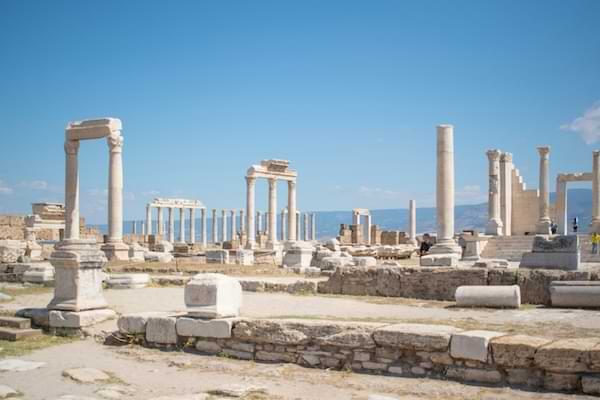
The seven churches – Laodicea

The seventh and final church Jesus addresses in the Revelation is the church in Laodicea. Laodicea was located near Colossae and Hierapolis in the fertile Lycus valley. A major Roman road ran from Ephesus straight through Laodicea, making it an important center for trade, commerce, and banking. The city was known for its much sought-after black wool and eye ointment for healing. It was also known for its great wealth, its large market, a medical school, and, additionally, for its inferior water supply. 

Despite its abundant wealth and possessions, Laodicea had terrible water. The city received its water from an aqueduct about six miles long. The water came from a hot spring in the south or a natural spring of cool water. Regardless of the source, once the water traveled six miles, it arrived in Laodicea lukewarm and of poor quality.

Jesus compared the Christian church in Laodicea to their water, saying the spirit of the people there was “lukewarm” as well.

What do the words of Jesus, the “Amen, the faithful and true witness,” teach Christians today?

Why is lukewarm faith undesirable to God?

Jesus was our example of a faithful, true witness for God. He was and is God himself and has been with God from “the beginning of God’s creation” (Revelation 3:14). Those in Laodicea and today can know that his words are accurate and of God. Jesus told the church, “I know your works: you are neither hot nor cold, I will spit you out of my mouth” (Revelation 3:15).

God wants us to be passionate about what we believe and to serve him with that passion. Living with an expressionless faith means living a life that doesn’t serve God or his kingdom purpose. Apathy does not lead others to know God or become his children.

I’ve often said it’s easier to lead a person to faith if they are antagonistic rather than apathetic toward the gospel message. It’s challenging to have a meaningful conversation with a person who politely listens but doesn’t really care one way or the other. I’d rather argue with someone than have them pretend to agree when they don’t. A genuine faith relationship with God has passion. 

Jesus told them, “I know your works.” Do our actions point clearly to our faith, or do people wonder what we genuinely believe? Do we believe the Bible to be God’s perfect truth, or do we consider some parts of it as possible suggestions for our choices? Does God find our works undesirable?

Our definitions for success compared to God’s

The people in Laodicea didn’t have great drinking water, but they were comfortable in almost every other way. They had better food, clothing, housing, and medical care. The residents felt prosperous, not needing anything. But Jesus told them they didn’t realize that in God’s eyes, they were “wretched, pitiable, poor, blind, and naked” (Revelation 3:17).

God always sees our “works” with an eternal perspective. It’s normal to measure our lives using earthly standards. If we have worked hard, saved, and tried to spend well, we probably have been able to afford medical care, a home, a car, and many other things we acquire to enjoy our lives.

Jesus would want us to ask ourselves, “What have I done that has produced eternal benefits?”

Do our works last for a finite time on this earth, or can God reward them as treasure in heaven? Have we received all our praise from people around us, or will we receive praise from God on our day of judgment? The praise we should strive to seek is “well done, my good and faithful servant” (Matthew 25:21). 

Jesus told the church in Laodicea, “I counsel you to buy from me gold refined by fire, so that you may be rich, and white garments so that you may clothe yourself and the shame of your nakedness may not be seen, and salve to anoint your eyes, so that you may see” (Revelation 3:18). Jesus was likely referring to the banking industry from which the people accumulated their unrefined “gold.” He spoke to the popular “black wool” they enjoyed wearing, telling them they needed his garments of white to clothe themselves in forever. And they needed his “salve” for their eyes so they could truly see what matters. 

Then Jesus told them that God would never be “apathetic” in his relationship to them.

God’s discipline is our great help

Jesus said, “Those whom I love, I reprove and discipline, so be zealous and repent” (Revelation 3:19).

Apathy and earthly wealth had caused even the Christians in Laodicea to become “lukewarm” and passionless in their faith. That can be, and usually is, still true for Christians today. God doesn’t want to spew us from his mouth, so he will continuously do whatever is necessary to bring us back into a right relationship, a relationship of passionate faith with himself.

Jesus said he will “stand at the door and knock.” In the original language, he said, “I will knock and keep knocking.” When we repent, we stop doing life by our own standards and begin to live by the biblical standards of our faith. God doesn’t give up on us until we are living a life that he is able to bless. When our works produce eternal rewards, we will have allowed our discipline to bring about the necessary changes we need for his blessed approval.

Why should we live with passionate faith and for eternal reward?

Jesus said, “If anyone hears my voice and opens the door, I will come in to him and eat with him, and he with me. The one who conquers, I will grant him to sit with me on my throne, as I also conquered and sat down with my Father on his throne” (Revelation 3:20–21).

Jesus told the church that the greatest blessings now and eternally will come from the works produced by our passionate, genuine, obedient faith. Genuine repentance brings us back into the presence of Christ now and eternally.

“He who has an ear, let him hear what the Spirit says to the churches” (Revelation 3:22).

When you have time, reread the direct, eternal teaching of Jesus’ words to the seven churches in Revelation, chapters 2 and 3. Revelation is the only book in the Bible that promises a blessing to the person who reads and obeys its words. “Blessed is the one who reads aloud the words of this prophecy, and blessed are those who hear, and who keep what is written in it, for the time is near” (Revelation 1:3).

Which of the seven churches most spoke to your personal needs? Which did you find most convicting? Jesus wants us to know his words to the churches because they clearly define the strengths and weaknesses that can impact our faith journeys.

Jesus knows our works, too. Even now, he stands at the door to our lives and keeps knocking until we allow him to enter, sit with us, and live in his Presence. We are blessed beyond measure to have these words from the book of Revelation. 

To those who have an ear, hear what the Spirit has said to each of these seven churches. May we all adjust our lives to his perfect, eternal teaching.
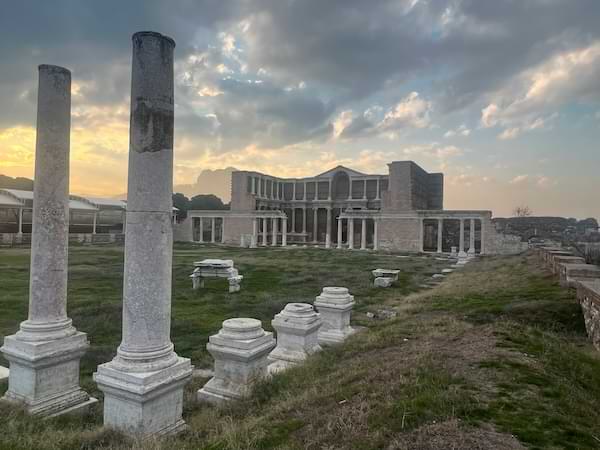

The seven churches: Sardis

When you were ready to choose a church to join, how did you decide which churches to visit? Did your choice follow an internet search, a friend’s advice, or maybe the congregation’s history of success? Jesus’ words to the church of Sardis speak to the importance of having a genuine, active faith and witness to the world, rather than simply relying on an appearance or a past reputation of faith.

Sardis was about thirty miles south of Thyatira and an important city for commerce and strategic military defense. A road ran through it, and because of its topography, it was used as a refuge when the people were threatened. Historically, the city had only been taken captive twice because natural, almost vertical rock walls surrounded it on three sides. The region was wealthy because of its commerce and trade, especially wool and other fabrics.

Sardis boasted an acropolis dedicated to Artemis and a large necropolis, or burial ground, just a few miles from town. Sardis was a strong city for the first two hundred years of Christian history, but was likely showing signs of decline when John received the Revelation.

Jesus identifies himself to the church in Sardis as the one “who has the seven spirits of God and the seven stars” (Revelation 3:1a). Jesus wants the church to know two essential truths: 

  • He controls the seven spirits of God. 
  • His Spirit bestows the blessings, guidance, and judgment upon all the churches.

What did Jesus know about Sardis and want them to do?

Jesus said, “I know your works. You have a reputation of being alive, but you are dead” (Revelation 3:1b). The city of Sardis was practically immune to attack from foreign enemies and comfortable economically. The city’s citizens were thought to be easily successful and generally unafraid. The city had an excellent reputation because of its history, but a closer look revealed the people had grown weak and apathetic because of the ease of their lives.

Apparently, the city’s apathy had also influenced the Christian church. Jesus told that church, “Wake up, and strengthen what remains and is about to die, for I have not found your works complete in the sight of my God” (Revelation 3:2). 

Jesus knew apathy was a greater weakness than people realized. Jesus knew their works, whether they were of God or not. The church’s reputation was good with others, but not with God. 

Why is apathy unacceptable to God?

God’s standards for our lives are much higher than we tend to recognize. So often, we measure the success of our spiritual lives by the standards of those around us. We tend to compare our church programs with those of a sister church in the same city. Reputations are often gained by using earthly standards rather than God’s. Jesus taught Sardis that their works might be good in the eyes of others, but God disapproved of them.

Jesus said, “I have not found your works complete in the sight of my God.” God’s biblical standards are the only standards we can use to measure spiritual success. Our works might earn us a good reputation with others, but if we haven’t been obedient to God’s Spirit-led guidance, our works are “incomplete” in his eyes. Our good ideas can earn us a good reputation, but following God’s plan is the only option for those who want to please him.

What is God’s solution for apathy?

Jesus clearly taught the church in Sardis what they needed to do:

  • “Wake up” and “strengthen what remains and is about to die.
  • “Remember” the teaching they had received and heard.
  • “Obey” and “repent” so they could return to God’s favor and blessing.

Jesus told the church, “If you will not wake up, I will come like a thief, and you will not know at what hour I will come against you.” Jesus wanted them to know that God would judge their lack of genuine, Spirit-led faith if they did not change. They needed to stop accepting what was unacceptable to God. Their reputation was good with others, but it was God’s expectations they were required to fulfill.

What is God’s reward for those who remain strong?

It seems most in the church had relaxed God’s standards for their faith, but not all. Jesus pointed out that the church still had a few people who had not “soiled their garments” and walked obediently with Jesus in a pure way, wearing “white.” Jesus commended these, saying, “They are worthy.” (Revelation 3:4)

No church is filled with saints or hypocrites. Every church has both, and there is grace for the humanity we all wrestle to overcome. We can’t completely avoid sin, but Jesus told us that through his grace and power, we can conquer that sin.

Peter preached the gospel message to the Jewish people who had gathered in the temple portico. They had just witnessed the healing of the lame man at the temple gate called Beautiful. Peter called on them to: “Repent therefore, and turn back, that your sins may be blotted out” (Acts 3:19).

Those who accept Jesus can know their salvation is assured. But our faith can become apathetic over time. Just as Jesus told the church in Ephesus to return to their first love, he also told the church in Sardis that their garments had become soiled. Christians must notice when we have lost our ability to walk with Jesus “in white.” Everyone, including apathetic Christians, needs to repent of the sins we can easily accumulate. Those sins might not impact our reputation with others, but they certainly change our walk with Jesus.

What did Jesus promise those who conquer their apathy?

Jesus said, “The one who conquers will be clothed thus in white garments, and I will never blot his name out of the book of life. I will confess his name before my Father and before his angels” (Revelation 3:5).

The solution to spiritual apathy is to step into a vital faith relationship with Christ as our King. Those who are saved will be clothed in “white” and found “worthy.” A Christian’s name will never be removed from the book of life. And Jesus will stand with us before his Father and before his angels and confess our “name,” our character in Christ, to them.

We can lose the vitality of our daily walk with God. Thankfully, through repentance, we can gain it back. We can never lose our salvation, but we can lose some of the heavenly reward Jesus taught us to “store up” in heaven through our genuine, Spirit-led works here on earth.

Imagine hearing Jesus speak your name to God and the host of angels in heaven saying, “This name is written in the book of life.” Then hear Jesus share with God all you accomplished in obedience to his Spirit. Don’t we all long to hear our Abba say, “Well done, my good and faithful servant.

What do we need an ear to hear?

The Holy Spirit speaks these lessons to the seven churches in Revelation. Every church and every Christian has been given God’s Holy Spirit and his holy standards. We are called to evaluate our lives by those standards

What happened in Sardis still happens today. We judge people, churches, and even ourselves by a “reputation” when we need to use God’s biblical standards instead. We might appear better than some, but the only reputation that matters is where we stand in God’s eyes.

Let’s ask God to show us any areas of apathy in our spiritual lives. Then, let’s repent of our sins, praying for God’s forgiveness. After that prayer, we can put on those clean white clothes and walk closely with Jesus once again.

God’s word for America from Paul and Barnabas

One of the best things about God’s word is that it never holds back or softens truth. The Bible tells us David was a man after God’s own heart, but it also tells us about David’s sin with Bathsheba. Scripture tells us about Noah’s faithfulness and the shame he experienced later in life. Paul was quoting ancient truth when he wrote to the Christians in Rome, “None is righteous, no, not one; no one understands; no one seeks for God. All have turned aside; together they have become worthless; no one does good, not even one” (Romans 3:11–12). A few sentences later, he told them everyone sins and falls short of God’s glory (Romans 3:23). 

Paul was stating the ancient biblical truth that because of the Fall, human beings will never be good enough for heaven without a saving faith. Jesus died because we needed him to pay for our sins. The Bible doesn’t withhold truth about even our greatest heroes of the faith because every one of the heroes needed to have a God who would save them. No one is born a saint, and everyone is born a sinner except Jesus.

Who are the winners and the losers?

The news media has discussed that question extensively in the past week. What is the biblical response and the thought every Christian should strive to remember?

“But God shows his love for us in that while we were still sinners, Christ died for us” (Romans 5:8). The winners in this world are the people who have accepted the free grace gift of salvation. The losers are the lost, those who have rejected Jesus. Christians live with the Light of the world so we can live as the light of the world. We are called to be one in Christ and one with each other.

Why, then, do we have so much trouble getting along?

Paul and Barnabas offer some advice

Paul would not have been able to do all he did for the Lord if not for Barnabas. The Bible doesn’t tell us about Barnabas’ sins, but we know he had some. When Barnabas spoke up for Paul in front of Peter, James, and the other church leaders in Acts 15, his words about Paul were received and respected. Obviously, Barnabas was a man who lived with a high and holy reputation.

On the other hand, Paul had a reputation that needed to be overcome. The early church accepted him largely because men like Ananias and Barnabas said they should. Paul and Barnabas traveled together, establishing churches and leading others to a saving faith in Christ.

They did this until they got into an argument over John Mark. The Bible makes it clear that Paul and Barnabas thought they were right about John Mark, even though they disagreed. Bible history points out that they were both right and wrong.

These two saints were about to take their second missionary journey together. Barnabas thought they should take John Mark, even though the young man had abandoned them on the first missionary journey. Paul didn’t want John Mark to come, thinking they might repeat the same mistake twice. 

The Bible says, “there arose a sharp disagreement, so that they separated from each other” (Acts 15:39). Two devout Christians, called and gifted by God, couldn’t agree and decided not to work together. You might say they “agreed to disagree.” The result? Barnabas did missionary work with John Mark, and Paul took Silas.

God redeemed the disagreement and used all these men for his higher purpose. We know that Paul later reconciled with both Barnabas and John Mark because he mentions them in 1 Corinthians 9:6 and 2 Timothy 4:11 using words of praise.

If Paul and Barnabas could give Christians in America some advice today, it might stem from their own experience. These two men might remind us that every Christian on earth is still a sinner. We should expect to disagree, even with our brothers and sisters in Christ. But our disagreements shouldn’t stop us from serving God’s kingdom purpose. When we “sharply disagree,” God can redeem our sins for his greater good.

If we ask a wrong question, we will get a wrong answer

When Christians disagree, it is rarely over who is right or wrong. Instead, we should ask ourselves, “How are we both right and wrong?” We should also ask, “What does God say is right about our point of view, and what is wrong?” 

Sometimes, we remain at a place of sharp disagreement. If so, agree to disagree and move forward, together or separately, with God’s calling. 

The modern trend in our culture is to take a side and defend it. The problem is both sides can make some good points. None of us are perfectly right or completely wrong. We are just a bunch of sinners who likely want to “feel right” more than we try to “be right.”

What is the first question to get right?

What has God said about it? If we care more about what God thinks and wants than what we might feel is best, the correct answers will likely follow. 

If Paul and Barnabas can sharply disagree, so can we. The truth is found at the end of their lives and ministries when they once again thought highly of one another. All of them, John Mark included, knew that God had redeemed their disagreement for his greater good.

Since Adam and Eve were kicked out of the garden, God has been doing great things through a bunch of sinners. We can expect God to continue doing the same until we join him in heaven.

Paul and Barnabas were both passionate about serving Christ, and they did serve him well. We should be less worried about conflict and more confident about God. Truthfully, the absence of conflict often indicates the presence of apathy.

Christians need to become as passionate about God’s word as others are passionate about their point of view. We are called to be the “light of the world.” We can disagree with the world and one another, but we must agree with the humility that comes from knowing only God will get it perfectly right.