The seven churches – Laodicea

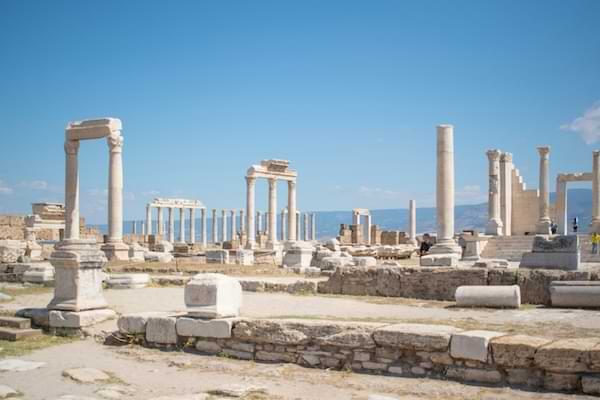
The seventh and final church Jesus addresses in the Revelation is the church in Laodicea. Laodicea was located near Colossae and Hierapolis in the fertile Lycus valley. A major Roman road ran from Ephesus straight through Laodicea, making it an important center for trade, commerce, and banking. The city was known for its much sought-after black wool and eye ointment for healing. It was also known for its great wealth, its large market, a medical school, and, additionally, for its inferior water supply. 

Despite its abundant wealth and possessions, Laodicea had terrible water. The city received its water from an aqueduct about six miles long. The water came from a hot spring in the south or a natural spring of cool water. Regardless of the source, once the water traveled six miles, it arrived in Laodicea lukewarm and of poor quality.

Jesus compared the Christian church in Laodicea to their water, saying the spirit of the people there was “lukewarm” as well.

What do the words of Jesus, the “Amen, the faithful and true witness,” teach Christians today?

Why is lukewarm faith undesirable to God?

Jesus was our example of a faithful, true witness for God. He was and is God himself and has been with God from “the beginning of God’s creation” (Revelation 3:14). Those in Laodicea and today can know that his words are accurate and of God. Jesus told the church, “I know your works: you are neither hot nor cold, I will spit you out of my mouth” (Revelation 3:15).

God wants us to be passionate about what we believe and to serve him with that passion. Living with an expressionless faith means living a life that doesn’t serve God or his kingdom purpose. Apathy does not lead others to know God or become his children.

I’ve often said it’s easier to lead a person to faith if they are antagonistic rather than apathetic toward the gospel message. It’s challenging to have a meaningful conversation with a person who politely listens but doesn’t really care one way or the other. I’d rather argue with someone than have them pretend to agree when they don’t. A genuine faith relationship with God has passion. 

Jesus told them, “I know your works.” Do our actions point clearly to our faith, or do people wonder what we genuinely believe? Do we believe the Bible to be God’s perfect truth, or do we consider some parts of it as possible suggestions for our choices? Does God find our works undesirable?

Our definitions for success compared to God’s

The people in Laodicea didn’t have great drinking water, but they were comfortable in almost every other way. They had better food, clothing, housing, and medical care. The residents felt prosperous, not needing anything. But Jesus told them they didn’t realize that in God’s eyes, they were “wretched, pitiable, poor, blind, and naked” (Revelation 3:17).

God always sees our “works” with an eternal perspective. It’s normal to measure our lives using earthly standards. If we have worked hard, saved, and tried to spend well, we probably have been able to afford medical care, a home, a car, and many other things we acquire to enjoy our lives.

Jesus would want us to ask ourselves, “What have I done that has produced eternal benefits?”

Do our works last for a finite time on this earth, or can God reward them as treasure in heaven? Have we received all our praise from people around us, or will we receive praise from God on our day of judgment? The praise we should strive to seek is “well done, my good and faithful servant” (Matthew 25:21). 

Jesus told the church in Laodicea, “I counsel you to buy from me gold refined by fire, so that you may be rich, and white garments so that you may clothe yourself and the shame of your nakedness may not be seen, and salve to anoint your eyes, so that you may see” (Revelation 3:18). Jesus was likely referring to the banking industry from which the people accumulated their unrefined “gold.” He spoke to the popular “black wool” they enjoyed wearing, telling them they needed his garments of white to clothe themselves in forever. And they needed his “salve” for their eyes so they could truly see what matters. 

Then Jesus told them that God would never be “apathetic” in his relationship to them.

God’s discipline is our great help

Jesus said, “Those whom I love, I reprove and discipline, so be zealous and repent” (Revelation 3:19).

Apathy and earthly wealth had caused even the Christians in Laodicea to become “lukewarm” and passionless in their faith. That can be, and usually is, still true for Christians today. God doesn’t want to spew us from his mouth, so he will continuously do whatever is necessary to bring us back into a right relationship, a relationship of passionate faith with himself.

Jesus said he will “stand at the door and knock.” In the original language, he said, “I will knock and keep knocking.” When we repent, we stop doing life by our own standards and begin to live by the biblical standards of our faith. God doesn’t give up on us until we are living a life that he is able to bless. When our works produce eternal rewards, we will have allowed our discipline to bring about the necessary changes we need for his blessed approval.

Why should we live with passionate faith and for eternal reward?

Jesus said, “If anyone hears my voice and opens the door, I will come in to him and eat with him, and he with me. The one who conquers, I will grant him to sit with me on my throne, as I also conquered and sat down with my Father on his throne” (Revelation 3:20–21).

Jesus told the church that the greatest blessings now and eternally will come from the works produced by our passionate, genuine, obedient faith. Genuine repentance brings us back into the presence of Christ now and eternally.

“He who has an ear, let him hear what the Spirit says to the churches” (Revelation 3:22).

When you have time, reread the direct, eternal teaching of Jesus’ words to the seven churches in Revelation, chapters 2 and 3. Revelation is the only book in the Bible that promises a blessing to the person who reads and obeys its words. “Blessed is the one who reads aloud the words of this prophecy, and blessed are those who hear, and who keep what is written in it, for the time is near” (Revelation 1:3).

Which of the seven churches most spoke to your personal needs? Which did you find most convicting? Jesus wants us to know his words to the churches because they clearly define the strengths and weaknesses that can impact our faith journeys.

Jesus knows our works, too. Even now, he stands at the door to our lives and keeps knocking until we allow him to enter, sit with us, and live in his Presence. We are blessed beyond measure to have these words from the book of Revelation. 

To those who have an ear, hear what the Spirit has said to each of these seven churches. May we all adjust our lives to his perfect, eternal teaching.

The seven churches – Philadelphia

The ancient city of Philadelphia was about thirty miles southeast of ancient Sardis and located along a critical Roman highway. Philadelphia was established on a plateau in a river valley and became a fertile agricultural region. The area was known for producing many of the grapes used for making wines and other important agricultural crops. Unfortunately, this beautiful area was also known for its frequent earthquakes. A devastating earthquake in 17 AD destroyed most of the city. The emperor Tiberius assisted in the rebuilding efforts, and in gratitude, it was renamed Neocaesarea in his honor. The city’s leaders dedicated a temple in his name to commemorate his support further. 

We cannot be sure who first established the Christian church in Philadelphia, but we know the church there had a long history of faithfully serving the Lord. Eventually, the entire country fell to Muslim control, yet the city of Philadelphia was able to maintain a Christian population until 1392. Interestingly, many Christians are allowed to live in that region today.

The open door that Jesus would provide

Jesus told John to tell Philadelphia that the words to them were “the words of the holy one, the true one, who has the key of David, who opens and no one will shut, who shuts and no one opens” (Revelation 3:7). Jesus wanted the church to understand that his message to them was borne of his holy character as their Messiah.

Jesus then praised them saying, “I know your works. Behold, I have set before you an open door, which no one is able to shut. I know that you have but little power, and yet you have kept my word and have not denied my name” (Revelation 3:8). Jesus had admonished the church in Sardis for straying from the whole truth, but those in Philadelphia had remained true to the words of Christ and the gospel message. Even though others did not consider them powerful, Jesus would establish “an open door” in Philadelphia, which no one could shut. In other words, Philadelphia would always be a place for people to come and find the truth about how to enter heaven, a truth that would be eternal.

My husband was touring the ancient ruins of Philadelphia several years ago when a government official, a Muslim, handed him a copy of the letter from the Revelation to the church of Philadelphia. This government worker had been provided copies by a Christian organization that asked him to pass them out to those visiting. Philadelphia was still an “open door” more than two millennia later!

The “hour of trial” that will come to the unbelievers

Jesus praised the Christians in Philadelphia for keeping the faith, but then gave a clear warning to those persecuting them. Jesus said, “Behold, I will make those of the synagogue of Satan who say that they are Jews and are not, but lie—behold, I will make them come and bow down before your feet, and they will learn that I have loved you. Because you have kept my word about patient endurance, I will keep you from the hour of trial that is coming on the whole world, to try those who dwell on the earth” (Revelation 3:9–10).

There was a synagogue in Philadelphia, and apparently, the Jewish people in the city had said and done evil things to the Christians in God’s name. Jesus referred to them as a “synagogue of Satan” because their actions were not of God but prompted by Satan. Jesus assured those in Philadelphia that these Jewish believers would one day bow before them and learn that Jesus loved his followers because they had “kept” his word and patiently endured.

Theologians interpret Jesus’ following words (v. 10)  differently because we can’t be sure what the “hour of trial” means. We know that the day will come to the whole world and will be a day of judgment. Jesus said that those in the church would be spared the judgment that would come upon the unbelievers. This may be the judgment that occurs at the final coming of Christ, but could also point to the judgment that occurs for everyone upon entering heaven. We know this: Jesus promised that those who believe and faithfully endure on earth will be spared on that day because they are beloved.

Jesus said, “I am coming soon.”

The letter of Revelation was given to John toward the end of the first century. Many of the early Christians had passed away and had even been killed because of their faith in Jesus. So, why did Jesus say, “I am coming soon,” and we are still waiting two thousand years later?

That question will be asked until Jesus returns for the final time. According to historical records, Christians lived in Philadelphia as late as 1392. How many of them took their last breath on earth only to open their eyes and see Jesus coming to take them to heaven! 

The older we get, the faster the years seem to speed by. That fact is worrisome to many, but Christians can be encouraged. Jesus gave us this advice about waiting. He said, “I am coming soon. Hold fast what you have, so that no one may seize your crown” (Revelation 3:11). Could it be that “holding fast” in times of suffering will provide us our greatest rewards in heaven? One day, our faithfulness in our most challenging difficulties could be the blessings of our eternal crowns.

To the one who conquers . . .

If you were to visit the ancient ruins of Philadelphia today, you would see very little. Most of the ancient ruins are buried underneath the current, modern city of Alasehir in Turkey. The frequent earthquakes either ruined or buried much of the ancient city. Interestingly, several of the pillars the city was famous for remain standing. These pillars were constructed by carving and stacking one piece upon the next. When the ground shook, the pillars moved with the earth and either remained standing or were able to be rebuilt by stacking the original pieces. 

Jesus told the believers in Philadelphia, “The one who conquers, I will make him a pillar in the temple of my God. Never shall he go out of it, and I will write on him the name of my God, and the name of the city of my God, the new Jerusalem, which comes down from my God out of heaven, and my own new name.  He who has an ear, let him hear what the Spirit says to the churches” (Revelation 3:12–13).

The early Christians of Philadelphia were promised an “Open Door” that, against all odds, remains open today. AI reports, “While modern-day Alaşehir is primarily a Muslim city, there are still some Christian communities, including both Orthodox and Roman Catholic, and a growing number of evangelical Protestants. The city is also a titular see of the Roman Catholic Church, which indicates its historical significance as a Christian center. Additionally, the ruins of the ancient city, including the Church of St. John, are still preserved and visited by Christian pilgrims.”

The “open door” that Jesus promised remains open today in the Muslim country of Turkey! Many will one day enter heaven because Jesus wrote God’s name and character on them, and now they belong in the “new Jerusalem,” which comes down from God out of heaven. Christians carry the name of Christ now and eternally. 

Jesus will come soon. It may turn out to be the final day on earth or our final day on earth. Either way, Jesus will come for us. When he does, we will face the judgment day without fear because we are saved. For now, we are called to remain steadfast in our faith and look forward with hope to the reward we will receive for our “patient endurance” during this lifetime. 

Until that day, may our lives lead people to that “Open Door” that Philadelphia was promised. How many people will be in heaven forever because they knew you on earth? Our calling is to obey his word and keep his name. That is how we lead people to that “Open Door,” the gospel message, that no one can ever shut!

The seven churches: Sardis

When you were ready to choose a church to join, how did you decide which churches to visit? Did your choice follow an internet search, a friend’s advice, or maybe the congregation’s history of success? Jesus’ words to the church of Sardis speak to the importance of having a genuine, active faith and witness to the world, rather than simply relying on an appearance or a past reputation of faith.

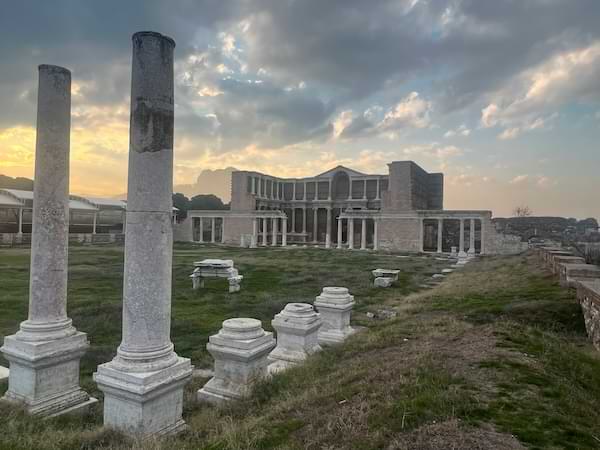
Sardis was about thirty miles south of Thyatira and an important city for commerce and strategic military defense. A road ran through it, and because of its topography, it was used as a refuge when the people were threatened. Historically, the city had only been taken captive twice because natural, almost vertical rock walls surrounded it on three sides. The region was wealthy because of its commerce and trade, especially wool and other fabrics.

Sardis boasted an acropolis dedicated to Artemis and a large necropolis, or burial ground, just a few miles from town. Sardis was a strong city for the first two hundred years of Christian history, but was likely showing signs of decline when John received the Revelation.

Jesus identifies himself to the church in Sardis as the one “who has the seven spirits of God and the seven stars” (Revelation 3:1a). Jesus wants the church to know two essential truths: 

  • He controls the seven spirits of God. 
  • His Spirit bestows the blessings, guidance, and judgment upon all the churches.

What did Jesus know about Sardis and want them to do?

Jesus said, “I know your works. You have a reputation of being alive, but you are dead” (Revelation 3:1b). The city of Sardis was practically immune to attack from foreign enemies and comfortable economically. The city’s citizens were thought to be easily successful and generally unafraid. The city had an excellent reputation because of its history, but a closer look revealed the people had grown weak and apathetic because of the ease of their lives.

Apparently, the city’s apathy had also influenced the Christian church. Jesus told that church, “Wake up, and strengthen what remains and is about to die, for I have not found your works complete in the sight of my God” (Revelation 3:2). 

Jesus knew apathy was a greater weakness than people realized. Jesus knew their works, whether they were of God or not. The church’s reputation was good with others, but not with God. 

Why is apathy unacceptable to God?

God’s standards for our lives are much higher than we tend to recognize. So often, we measure the success of our spiritual lives by the standards of those around us. We tend to compare our church programs with those of a sister church in the same city. Reputations are often gained by using earthly standards rather than God’s. Jesus taught Sardis that their works might be good in the eyes of others, but God disapproved of them.

Jesus said, “I have not found your works complete in the sight of my God.” God’s biblical standards are the only standards we can use to measure spiritual success. Our works might earn us a good reputation with others, but if we haven’t been obedient to God’s Spirit-led guidance, our works are “incomplete” in his eyes. Our good ideas can earn us a good reputation, but following God’s plan is the only option for those who want to please him.

What is God’s solution for apathy?

Jesus clearly taught the church in Sardis what they needed to do:

  • “Wake up” and “strengthen what remains and is about to die.
  • “Remember” the teaching they had received and heard.
  • “Obey” and “repent” so they could return to God’s favor and blessing.

Jesus told the church, “If you will not wake up, I will come like a thief, and you will not know at what hour I will come against you.” Jesus wanted them to know that God would judge their lack of genuine, Spirit-led faith if they did not change. They needed to stop accepting what was unacceptable to God. Their reputation was good with others, but it was God’s expectations they were required to fulfill.

What is God’s reward for those who remain strong?

It seems most in the church had relaxed God’s standards for their faith, but not all. Jesus pointed out that the church still had a few people who had not “soiled their garments” and walked obediently with Jesus in a pure way, wearing “white.” Jesus commended these, saying, “They are worthy.” (Revelation 3:4)

No church is filled with saints or hypocrites. Every church has both, and there is grace for the humanity we all wrestle to overcome. We can’t completely avoid sin, but Jesus told us that through his grace and power, we can conquer that sin.

Peter preached the gospel message to the Jewish people who had gathered in the temple portico. They had just witnessed the healing of the lame man at the temple gate called Beautiful. Peter called on them to: “Repent therefore, and turn back, that your sins may be blotted out” (Acts 3:19).

Those who accept Jesus can know their salvation is assured. But our faith can become apathetic over time. Just as Jesus told the church in Ephesus to return to their first love, he also told the church in Sardis that their garments had become soiled. Christians must notice when we have lost our ability to walk with Jesus “in white.” Everyone, including apathetic Christians, needs to repent of the sins we can easily accumulate. Those sins might not impact our reputation with others, but they certainly change our walk with Jesus.

What did Jesus promise those who conquer their apathy?

Jesus said, “The one who conquers will be clothed thus in white garments, and I will never blot his name out of the book of life. I will confess his name before my Father and before his angels” (Revelation 3:5).

The solution to spiritual apathy is to step into a vital faith relationship with Christ as our King. Those who are saved will be clothed in “white” and found “worthy.” A Christian’s name will never be removed from the book of life. And Jesus will stand with us before his Father and before his angels and confess our “name,” our character in Christ, to them.

We can lose the vitality of our daily walk with God. Thankfully, through repentance, we can gain it back. We can never lose our salvation, but we can lose some of the heavenly reward Jesus taught us to “store up” in heaven through our genuine, Spirit-led works here on earth.

Imagine hearing Jesus speak your name to God and the host of angels in heaven saying, “This name is written in the book of life.” Then hear Jesus share with God all you accomplished in obedience to his Spirit. Don’t we all long to hear our Abba say, “Well done, my good and faithful servant.

What do we need an ear to hear?

The Holy Spirit speaks these lessons to the seven churches in Revelation. Every church and every Christian has been given God’s Holy Spirit and his holy standards. We are called to evaluate our lives by those standards

What happened in Sardis still happens today. We judge people, churches, and even ourselves by a “reputation” when we need to use God’s biblical standards instead. We might appear better than some, but the only reputation that matters is where we stand in God’s eyes.

Let’s ask God to show us any areas of apathy in our spiritual lives. Then, let’s repent of our sins, praying for God’s forgiveness. After that prayer, we can put on those clean white clothes and walk closely with Jesus once again.

The seven churches: Ephesus

The seven churches of Revelation are located in Asia Minor, or modern-day Turkey. The Revelation is John’s letter that traveled to many churches, so his messages were for every church then and now. Yet, Jesus pointed out the specific strengths and weaknesses of each church, illustrating how those strengths and weaknesses can impact a church community as well as an individual’s walk of faith.

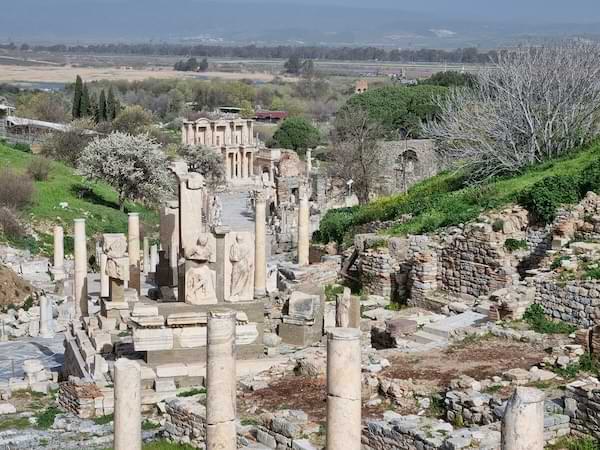
I remember the first time I walked through the streets of Ephesus, amazed at the beauty and grandeur of the ruins and antiquities. You can make a virtual visit” if you have never been there. Ephesus was a favorite city for some of Rome’s wealthy leaders. It’s located on the Aegean Sea with cool ocean breezes, making summer heat more bearable. In addition, it was located on a river that brought a continual source of fresh water. The wealthy from Rome could have owned a summer home in the city and often retired to that part of the world. Ephesus was also a major port city, making numerous goods from around the world available to those living there.

Why might Jesus have started with Ephesus?

In his revelation to John, Jesus mentions seven key churches in Asia Minor. Paul visited most of these churches on his missionary journeys. Ephesus was central to the region’s commerce, culture, and politics, and most Christians receiving John’s letter would have traveled to that city at some point.

Ephesus, a cultural seaport city, was well known for its many pagan practices and temples. The temple of Artemis, or Diana, is considered one of the “seven wonders of the world.” Diana was the goddess of fertility, and “worship” in that temple usually involved prostitution. Many sacrificial altars in the city involved dark and evil practices. 

It is thought that John brought Mary, the mother of Jesus, to Ephesus when they were forced to flee from Jerusalem. There is a home that is thought to be where she lived. The ruins of the Basilica of St. John are located next to the site where the apostle is said to have been buried. John ministered to all the churches mentioned in the Revelation, but apparently, Ephesus was his “home,” and Jesus spoke to that church first.

What did Jesus say about the church in Ephesus?

Jesus said, “To the angel of the church in Ephesus write, ‘I know your works, your toil and your patient endurance, and how you cannot bear with those who are evil but have tested those who call themselves apostles and are not and found them to be false. I know you are enduring patiently and bearing up for my name’s sake, and you have not grown weary” (Revelation 2:1–3).

The “angel” is likely the pastor who would have read John’s message to the church. The words read are the words of Christ who walks among the churches—the “golden lampstands” (Revelation 1:20). The job of the church and its congregation was to share the light of Christ with others. 

Those in the Ephesian church were given reasons to be proud of their character. John praised them for:

  • Their works or their Christian deeds done for the sake of the church and one another. They “toiled” to serve Christ through the church with patient endurance.
  • They did not put up with the people who “called themselves apostles” but were actually “evil.” John had written letters to these churches warning them to pay no attention to the Gnostics, a group that distorted the gospel of Christ and the original apostolic truth of Paul and others. The Gnostics’ message was considered more popular in Greco/Roman culture, and they had successfully turned some people away from the truth. The Ephesian church had not grown weary of faithfully honoring the pure truth of the Christian faith.

Jesus also said, “But I have this against you, that you have abandoned the love you had at first” (Revelation 2:4). It’s difficult to fully understand what Jesus meant when he spoke those words. We know these churches had likely existed for about forty or fifty years by this time. Many in the early church were convinced that Christ would return quickly, yet decades had passed without his final coming. Life as a Christian in Ephesus had become increasingly difficult, and many suffered physically, mentally, and financially to continue in the Christian faith. Jesus praised them for their patient endurance but then told them they had “lost their first love.” Quite possibly, their devotion to Jesus and to sharing the gospel message had changed. Jesus told them to “remember” and “repent” or turn back to the “works” they had done at first. 

Remembering our “first love” for Christ is always a good idea—heartfelt gratitude and praise we felt when we realized our souls had been saved and heaven was our promised hope. We eagerly shared our faith with others, excited to share the good news. 

We are to love Jesus now, just as we loved him then. Jesus wants us to remember Easter and all he did to give us eternal life with God as our Father. 

The message to the Ephesian church reminds us that we can be faithful to our works or deeds at the church, yet forget to gratefully love and honor the One who is the reason for our church community of faith. 

Jesus told the Ephesian church, “I will come and remove your lampstand from its place, unless you repent” (Revelation 2:5). In other words, the light of God’s word is hindered or even extinguished if it does not shine through people who love its Author.

What does Jesus hate?

Jesus continued his message to the church in Ephesus with one last important message. He said, “Yet this you have: you hate the works of the Nicolaitans, which I also hate” (Revelation 2:6). 

Much study and writing have been done about the Nicolaitans, a group we don’t know much about. A Christianity Today article said, “The Nicolaitans appeared to conform to this Roman culture and seemed to encourage Christians in Ephesus to do the same in a time of dire persecution (1 Corinthians 6:12). In eating the food given to the idols. This implies they had gone to the temples to receive the food and would’ve had to engage in the immoralities there to acquire this meat.” Some believe a man, possibly named Nicolas, had led some in the church to compromise their faith to make their lives more bearable or pleasant. Jesus praised those who “hated” that behavior and said he hated it as well. The Christianity Today article also said, “Overall, the warnings against the Nicolaitans in Revelation emphasize the importance of maintaining the purity of the Christian faith and avoiding compromise with practices that are contrary to the teachings of Christ.”

The message to Ephesus

Jesus closed his message to the church in Ephesus, a message for every church, saying, “He who has an ear, let him hear what the Spirit says to the churches. To the one who conquers I will grant to eat of the tree of life, which is in the paradise of God” (Revelation 2:7).

Those who are Spirit-led are privy to the voice of Jesus in their lives today. Jesus promised those Spirit-led believers that they could look forward to an eternity in the “paradise of God.”

If your “first love” has faded, or if you have accepted teaching that is contrary to the pure perfection of God’s word, you can “repent” and turn back to a purer faith walk with Christ. All of us need to “have an ear” and “hear what the Spirit says to the churches” and to us.

These messages are timeless truth, directly from the teaching of Christ to John. We are blessed to read and study his truth. We will be abundantly and eternally blessed if we will listen and heed it today.