

The Lancaster Lifestyle

The quiet life of the plain people

Previously, my only experience with the Amish lifestyle was through novels and movies. Then I made a trip to Lancaster County in Pennsylvania, and I spent some time among the Amish. I found their lifestyle fascinating and thought-provoking.

I’ve always loved—but have struggled to live—the passage in 1 Thessalonians 4:10–12 that says, “But we urge you, brothers, to do this more and more, and to aspire to live quietly, and to mind your own affairs, and to work with your hands, as we instructed you, so that you may walk properly before outsiders and be dependent on no one.”

I aspire to live that verse, but it requires effort and choice to find that kind of quiet in my Dallas life. Nevertheless, that’s the verse that kept coming to mind as I drove past the farms in Lancaster County and visited stores and other places intended to reflect the Amish way of life.  

If there were some kind of apocalyptic occurrence in the world, I imagine the Amish in Lancaster County would be far better off than the rest of us. In fact, I wonder if a catastrophe would impact them much at all.

Their daily lives would look familiar, even now, to their ancestors. In contrast, my grandparents would be astonished to see everything that this computer I’m typing on is able to accomplish. For that matter, my mom is still astonished on occasion. Change seems to be a constant in our lives, but the Amish still use oxen to plow their fields and horses to pull their buggies.

The Amish have chosen to stay separate from the rest of the culture and take care of themselves, their families, and their community. They raise their children to depend on God and hopefully choose the Amish lifestyle for their futures. The times change, but they have chosen not to change with them—at least not too much. The Amish buggy I followed down the highway had turn signals!

Is the Amish lifestyle what the apostle Paul intended when he wrote 1 Thessalonians 4:10–12?  

Why do the Amish choose to live a “plain” life?

I was surprised to learn that my theological roots are closely related to those of the Amish. The Amish and the Baptists both trace their beginnings to a group called the Anabaptists, who were persecuted during the Protestant Reformation because they did not believe in infant baptism. Those Christians were forced to flee from their homeland because many were being put to death for “defying” the traditional Catholic faith.

Eventually, the Amish and Mennonite people left Europe in the 1720s and 1730s and accepted William Penn’s offer of religious freedom. That is why they settled in the area that later became known as Pennsylvania. Many are still in that area today, on the same land their ancestors farmed.

I enjoyed my time in Lancaster County. We discovered a family restaurant that offered traditional Mennonite recipes. The food was wonderful, the pies were amazing, and the servers were quietly kind and seemed to enjoy serving. The walls of that restaurant were covered with Scripture. It felt like a privilege to eat there. Truthfully, I felt a little sad to pull away from that very simple, very plain, and very comfortable hotel room in Lancaster.  

There is something to be said for the “plain” lifestyle, but is that how all of us should interpret the passage in 1 Thessalonians 4:10–12?  

That is the thought that has given me pause since returning home. Paul said to live quietly; to mind our own affairs; to work with our hands; to walk properly before outsiders and be dependent on no one.

Those words seem to describe a lifestyle that looks more Amish than the way most of us have chosen to live.

Why did Paul speak those words to the Thessalonians?  

Thessalonica was a busy seaport in Macedonia, and one of the largest, most important cities Paul visited. Paul taught in the synagogue there, doing his best to convince people that Jesus was their long-awaited Messiah.

Acts 17:1–10 describes Paul’s time in the city. Acts 17:5 says, “The Jews were jealous, and taking some wicked men of the rabble, they formed a mob, set the city in an uproar, and attacked the house of Jason, seeking to bring them out to the crowd.”  Paul was forced to flee to Berea, but his message, after just three days of preaching, was received by many in that important city, and a significant Christian church was formed and tasked with reaching their culture.

Later, Paul wrote his letters to the church, trying to help those new Christians protect themselves from the same persecution he had faced. He complimented them on their faith and told them, among other things, to live quietly, separately, work hard, and try not to depend on others for their livelihoods. In context, Paul’s words were given to help those early Christians survive in an angry culture that didn’t like their message.  

Paul’s life is his message as well

The Anabaptist people needed that same teaching to survive the persecution of their day so they came to Lancaster County, Pennsylvania. They chose to maintain that way of life to protect their faith, even after coming to a land that gave them permission to worship freely. In many ways, the Amish have lived as a persecuted people, even though they were free.  

And that is a point to consider today. If Paul was teaching that a quiet life, lived separately from the world and not dependent on others, was the “Christian” lifestyle, then Paul didn’t choose to live as he taught. Neither did Jesus. Both Jesus and Paul lost their lives because they did not separate from the world; they preached to it.

In fact, that is the lifestyle most of our biblical heroes were called to lead.  

How then should we live today?

Jesus prayed for his followers, saying, “My prayer is not that you take them out of the world but that you protect them from the evil one” (John 17:15 NIV).

Jesus knew that it would be difficult for Christians to live their faith around people who didn’t follow God’s plan for their lives. Jesus knew that human beings will always struggle to submit to God’s sovereignty because Satan, the evil one, will always work to separate people from God’s plan.  

But, if Jesus prayed for our protection, shouldn’t we trust that God answered that prayer?

It was right for Paul to teach the Thessalonian church (and consequently the early Anabaptists) how to survive in a culture that was trying to take the lives of the faithful followers of God. It was also right for Paul to continue to live in the midst of his culture in order to fulfill his calling.

And that is the point for all of us today. I wish there were a strict set of rules each of us could follow to guarantee we were leading a godly lifestyle. We have God’s laws, and they are still truth, but God also gave us his Holy Spirit to guide each of us to the life and calling he wants for our lives.  

What is your calling?

It’s important to remember that our calling will never break God’s laws, but the Holy Spirit will teach us how to fulfill our calling with the people around us.  

I was impressed by what I saw in the Amish way of life, and I wish I had more time to live amongst them. At the same time, I’m called to live in Dallas and freely serve God as his Holy Spirit leads. My “quiet” life is better described by the quiet confidence and peace that accompanies a busy, suburban lifestyle and ministry.  

Like Paul, we each have to run our own race. God’s Holy Spirit will teach us which lane is ours, how fast to run, and which direction to go. Those instructions will probably change daily, weekly, and yearly.

Galatians 5:25 says, “If we live by the Spirit, let us also keep in step with the Spirit.” Walking with the Spirit is the plain truth, for plain people, who want to live the life God has called them to live.

There may be days ahead when God’s Spirit instructs us to live like Paul taught the church in Thessalonica and the early Anabaptists. For now, we are free to teach and preach the gospel message to a world that needs to hear it.

And if one day God were to call me to live more like the Amish people, I think I would enjoy that ministry as well!

5 Tips for a Stronger Summer Soul

I’m done teaching my Bible study for this year, and so I’m writing this article for my own sake as much as yours.

It’s a lot easier for me to stay close to the Lord when I have to teach his Word each week. I usually spend a lot of time studying and preparing lessons as well as praying for the wisdom to teach them. Then summer rolls around and I spend less time relying on God and more time enjoying my coffee.

I want to do a better job enjoying both!

Now, I’m all for a summer break. We need some downtime once in a while. I will start to write next year’s Bible study in a couple of weeks and that will help. But, there are a few things that I try to do, especially in these summer months, to keep my soul inspired and God’s direction front and center each day. I thought I’d share those ideas with all of you.  

These are my ideas, but I would love to hear some of yours. Use the comment section or our Facebook link to share your thoughts.

1. Rise early.

“Joy comes with the morning” (Psalm 30:5).  

The summer days are longer, but they will also get hot (especially in Texas). I like to have my first cup of coffee early, while I read The Daily Article, my husband’s morning essay, and the First15 devotional, written by my son.

Most of you probably get these already, but if you don’t, you should! Spending your time with these words about God will often inspire a word from God.

How do you take that word into your soul?

Put on comfortable shoes and start walking. Consider what God has spoken to you, and, chances are, God will speak words through you that day.

We all need to consume God’s thoughts if we want to have a well-fed soul.

2. Go to bed early.

“It is in vain that you rise up early and go late to rest, eating the bread of anxious toil; for he gives to his beloved sleep” (Psalm 127:2).

This is an obscure verse of Scripture, but it shouldn’t be!

Have you ever stopped to consider why we were created to need sleep?

God didn’t have to create us with that need, but he did. A ton of studies discuss the importance of sleep to our physical bodies, but have you ever thought about the benefits of sleep to our souls?

God can speak to us as we dream. Have you asked him to?

A good night’s sleep is healing to every aspect of our lives. We weren’t meant to work and toil all day. God wants us to rest, and to rest in him.

Give God your dreams, and, each morning, as you are thinking about what you have dreamed, ask God what he might be speaking to your soul.

3. Spend time on your friendships.  

“Two are better than one, because they have a good reward for their toil. For if they fall, one will lift up his fellow. But woe to him who is alone when he falls and not another to lift him up!” (Ecclesiastes 4:9–10).

There are so many people in this world I would love to know better. I wish I knew all of you, for example!

But there are only twenty-four hours to a day, and there are a lot more acquaintances in our lives than there are friends.

Heed King Solomon’s words: don’t just spend time with friends; spend some time on your friends.

Our friends should not just be good company. They should be people who strengthen our walk with the Lord and bless our souls—and we should be that kind of friend to them as well.

4. Experience God in an ancient, new way.  

“The steadfast love of the Lord never ceases; his mercies never come to an end; they are new every morning; great is your faithfulness” (Lamentations 3:22–23).

These are familiar and favorite verses. God’s people have been sharing God’s wisdom for centuries. Add something to your spiritual journey that is ancient wisdom but new to you.

There are books of Christian quotes, websites with old sermons, and Christian novels written decades ago. There is something particularly refreshing to our souls to read words that God inspired in the past that are still his truth today.

God is timeless and timely. If he inspired truth one hundred years ago, it is still truth today.

5. Take time to enjoy God’s warmth.  

“You make known to me the path of life; in your presence there is fullness of joy; at your right hand are pleasures forevermore” (Psalm 16:11).

I have to admit, I love the warmth of summer. I love warm weather, flowers, vacations, swimming, and long, lazy walks on a beach. I love the sun on my toes and a great novel in my hands. I love long days and a slower work schedule.

And I love that I have time to just love the One who provides it all.

Fall will arrive, if Jesus doesn’t. I would love for all of us to look back on these summer months with gratitude for the time we spent just enjoying our God. He would enjoy our enjoyment. Our souls were made to find joy in our Father.

Your soul was created to enjoy its Creator. And he wants to spend these summer days with you, joyfully present in your life.

Strengthen Your Summer Soul

Those are my tips, and you can go to my website or Facebook page to share yours.

The summer months will come and go. Don’t you want to use them to strengthen your soul?

If you are like me, then some weeks will probably be better than others—but I’d like to have more of those great weeks. God gave us the season we call summer. He had to have a perfect reason! Let’s plan to enjoy the days ahead because we trust that God has a plan to strengthen our souls with his joy.

That First Fire of the Season

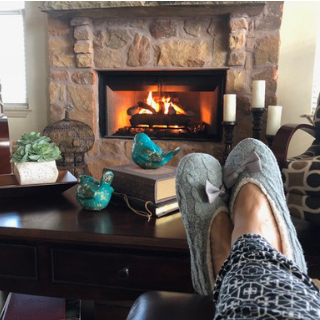
I peeked at the thermostat and shivered. It was 48 degrees on Saturday morning at Possum Kingdom Lake. So, I turned on the coffee and reached for the fireplace remote. A few minutes later, I sat quietly with my warm mug, watching the flames and enjoying every moment of the morning.

October was a blur. Travel always seems to do that. Those days in Israel were amazing, but sitting in my favorite spot at the lake was a great reminder that my life is abundantly blessed. It’s November and I have a lot to think about. A warm fire and a hot cup of coffee create a perfect setting for those thoughts.

I’ve always been an early riser, but my parents were up even earlier. Almost every winter morning, I would come down the hall and see my mom and dad sitting by the fireplace, drinking their coffee. I remember thinking, “One day, when I get married, I’m going to sit in front of the fireplace and drink coffee with my husband too.” That didn’t work out very well. Jim gets up earlier than I do. He finishes his daily article, posts it to send, podcasts the content, and then takes off for his morning walk. AND, he doesn’t even drink coffee! (That’s probably a good thing . . . I’ve often remarked that no one would want to try to keep up with Jim—after caffeine.)

That said, God has provided me a lot of mornings to sit quietly, alone with my thoughts, a good cup of coffee and a fire on cold winter days. It is during these moments that God is most likely to place a person on my mind who needs prayer or a quick email of encouragement. God often uses these moments to direct my thoughts to what I should teach, write, or say that week. I read different devotionals and emails, and I almost always read Jim’s article and Craig’s First 15. I’ve found that if I can have my morning moments, the rest of the day just seems to work better.

I’m picturing all of you today, reading this email after listening to the morning news. I’m sure the news reports are filled with election results and opinions about those results. Some of you are waiting on your kids to get downstairs so you can run them to school. Many of you are grabbing your cup of coffee in a commuter cup so you can drink it on the way to work. I encourage all of you to carve out some moments of quiet in your busy day. God made us to be still.

Scripture doesn’t suggest “Be still and know that I am God” (Psalm 46:10). Scripture flat out commands it. I’ve often said that if we don’t find time to be still, other things will become a god to us. If work or family needs are more urgent than spending time with God, then work and family have become gods. The television, the computer, social media, and cell phones can all become gods if we take time to be still with them instead of the Creator of all things. God doesn’t demand we spend time with him. Instead, he taught us a result of spending time with him. We will know that he is God.

I’m grateful that you read this blog each week, and I hope you will continue. But, I want you to close the computer and be still with God as a result. He has so much to say to you, from the pages of your Bible and from the quiet thoughts the Holy Spirit will author as you take the time to be still with your Creator. Quiet is a powerful spiritual discipline. No wonder our world seems to get a bit noisier and a lot busier with each passing year.

Each year I write an Advent devotional for our ministry. I hope it will help you include a word about Christ into each day of your busy holiday season. The title of the devotional this year is Joy to Your World. Joy is an ongoing theme in the Christmas story and throughout Scripture. This year I rewrote Joy to Your World so that kids could have the devotional for themselves. That edition is available as well, offered from our ChristianParenting.org ministry.

If you would like to request a copy of either edition, we would love to send it to you. The children’s edition has a limited quantity, so don’t wait too long if you want that one. I hope these Advent devotionals will be a blessing to you and your families.

The quiet moments with God are the most important moments with God. I hope you will find some time to “be still” and embrace the joy of spending time with your heavenly Father. He adores you and wants nothing more than to fill those moments with his Presence.

I don’t sit by my fire with Jim in the mornings, but I don’t sit by my fire alone. Set your alarm, get the coffee ready to go, and crank up the fireplace if you have one. It just takes a little effort to be still, and God is waiting to make himself known to you in new and fresh ways. I wish you his great peace for today and the holiday months ahead.